
When we talk about suicidal ideation, you might imagine someone who is actively at risk of hurting themselves. But many people experience what's known as passive suicidal ideation. This is when you have a desire to die, but don't intend to go through with it.
Experiencing passive suicidal thoughts like this can start to feel like a "normal" part of your daily life, especially if you live with long-term depression. But there is hope with treatment. You don't need to accept feeling this way forever.
If you experience suicidal thoughts, whether they're passive or active, it's important to take them seriously. This article cannot replace medical advice or crisis support. If you are having thoughts about ending your life, call 988 or local crisis support services.
Our Mental Health IOP in the Glendale AZ therapy office is now open and accepting clients! This 12-week program meets 3 days a week for 3 hours each. Reach out to learn more.
What is passive suicidal ideation?
Passive suicidal ideation is when you want to die, but don't intend to die. You don't want to be alive anymore, but you also don't plan on actually ending your own life. People with passive suicidal thoughts may choose to stay alive for different reasons. For example, you might not want to hurt your loved ones, or you might be understandably afraid of death.
But just because you're not actively thinking about ending your life doesn't mean that passive suicidal thoughts can't be dangerous. Research has found that having passive ideation is a risk factor for suicide attempts, even if you don't have a plan.
More importantly, passive suicidal ideation is linked with feelings like hopelessness, helplessness, and worthlessness.
Experiencing passive suicidal ideation doesn't mean you're crazy or that something is wrong with you. It's more common than you think, but that doesn't mean you need to accept it as "normal." Often, it's a sign of an underlying mental health concern, like depression or trauma reactions. It deserves to be taken seriously.
What does passive suicidality feel like?
People can experience passive thoughts of suicide in different ways. Many people have thoughts about death. But your mind might not necessarily go immediately to death --- you may wish that you would just disappear (without thinking of death specifically).
Passive suicidal ideation can look like:
- Wishing you were dead, even though you don't actually want to end your life.
- Thoughts like, "I wish I could just go to sleep and never wake up." or "I just don't want to be here anymore."
- Feeling strongly that your life is meaningless.
- Feeling like the world or your loved ones would be better off without you.
- Fantasizing about disappearing or dying in ways that are out of your control, like dying in a plane crash.
- Not caring whether you live or die.
- Feeling like you're living your life on autopilot without caring what happens to you.
- Automatically seeing death as an "exit" when you're overwhelmed or in distress.
- Praying to God or a higher power to "let you die."
- Finding relief in thinking about your own death.
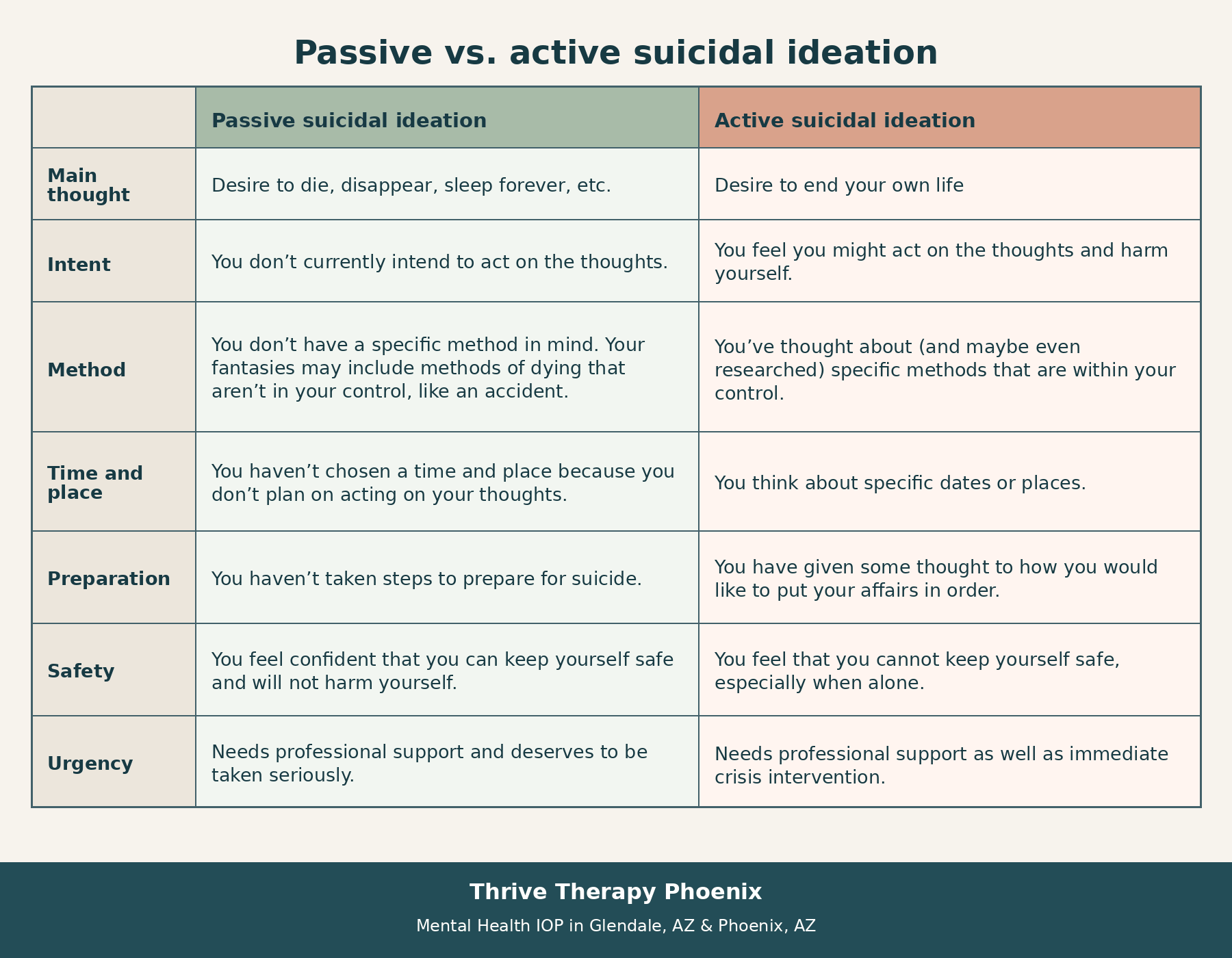
Passive vs active suicidal ideation
The key difference between passive and active ideation is that passive suicidal ideation doesn't involve intent or a plan. Here's a table that may help you understand the differences, although the line between them can sometimes be blurry.
Warning signs of passive suicidal ideation turning active
Passive suicidal thoughts can often become more active, especially as you start to feel more overwhelmed or depressed. This transition can sometimes be gradual; you think about dying more and more until you can't stop thinking about it. It's essential to notice when this happens. Many people go back and forth between passive and active suicidal ideation.
All suicidal thoughts need to be taken seriously, but if you have an intention or plan to end your life in the near future, then you may need more immediate support.
Pay attention to these warning signs:
- Your thoughts about death are becoming more frequent or difficult to dismiss.
- You start thinking about ending your own life instead of only wishing that you were dead.
- You begin researching or considering specific methods.
- You choose a possible date or place.
- You gain access to something you could use to hurt yourself, like a gun.
- You start writing goodbye messages or putting your affairs in order.
- You withdraw more than usual or stop reaching out for help.
- You feel more hopeless, like you'll never feel any differently.
- You use alcohol or drugs more often or take risks because you no longer care what happens.
- You feel unable to identify any reasons to stay alive.
- You become worried that you won't be able to keep yourself safe.
If you feel like you can't keep yourself safe, call or text 988 to reach the Suicide & Crisis Lifeline. You can also go to the nearest emergency room or call 911 if you're in immediate danger. Stay with someone you trust and move away from anything you could use to hurt yourself while you wait for help.
How to manage passive suicidal thoughts
It might feel to you like you've lived with these thoughts for as long as you can remember. You may feel hopeless that you'll ever truly be without them. But mental health treatment can help you overcome these thoughts, or at least manage them to the point where they no longer get in the way of your quality of life. It's possible to feel like life is truly worth living again.

Talk to a therapist early
You don't need to wait until passive suicidal thoughts become active to tell a therapist about them. Talking about the thoughts early gives you and your therapist more time to understand what triggers these thoughts and feelings and create a plan for managing your safety.
Some people avoid bringing up suicidal thoughts because they're afraid their therapist will immediately hospitalize them. Telling a therapist that you've had passive suicidal thoughts doesn't automatically mean you'll be sent to the hospital. Your therapist will likely ask questions about how intense your thoughts and feelings are and whether you have a plan to act on them.
Therapy is generally confidential. However, therapists may need to share limited information about suicidal behavior if they believe there is a serious and immediate threat to your safety. If you and your therapist both feel confident that you can keep yourself safe, then they can generally protect your confidentiality. You can ask your therapist to explain the limits of confidentiality before you talk about your thoughts.
Make a safety plan
A safety plan is a written, step-by-step plan for getting through painful moments when suicidal thoughts become more intense. It's best to create one with a therapist or another qualified mental health professional while you're feeling relatively stable, not after you're already in crisis.
Your safety plan might include your things like personal warning signs, coping strategies you can try on your own, safe people you can contact, and places you can go to distract yourself. It should also list professional and crisis resources, along with steps you can take to make your environment safer. This often means reducing your access to anything you might use to hurt yourself.
Keep the plan somewhere you can easily find it. You can save a copy on your phone and share it with someone you trust.
Tell your loved ones
Passive suicidal ideation can be incredibly isolating. You may worry that telling someone will scare them or make them think you're a burden. But letting at least one trusted person know what you're experiencing can give you someone to contact when you're feeling this way.
You could say something like, "I've been having thoughts about not wanting to be here anymore. I don't plan to hurt myself, but I need someone to know that I'm in a lot of pain."
Tell them what would actually be helpful right now and how to support you. You might want them to listen without trying to fix the situation. Or you might need someone to check in with you regularly or help you contact a therapist.
Be kind to yourself
Passive suicidal ideation may come in waves. They could become stronger when you're exhausted or isolated, or when something happens that triggers you. Try to notice these patterns without judging yourself for having them.
Having these thoughts doesn't mean that you'll feel this way forever, even if it might feel like that in the moment. Treat these thoughts as a sign that you're overwhelmed and need more support. Be compassionate and gentle with yourself. Follow your safety plan if you need to, and focus on getting through the next hour rather than solving the rest of your life.
Consider more intensive treatment
Weekly therapy isn't always enough, especially when suicidal thoughts are frequent or your mental health is affecting your ability to function. There are more intensive treatment options available that can offer more support.
An intensive outpatient program, or IOP, provides several hours of treatment on multiple days each week while allowing you to continue living at home. It can give you more structure and support than traditional outpatient therapy.
Some people can also benefit from residential treatment, especially if suicidal thoughts are severe. Residential or inpatient treatment provides 24-hour support for people who need more support than an IOP can offer.
If you're in immediate danger, however, an IOP or routine residential admission may not provide help quickly enough. Call 988, go to an emergency room, or call 911.
Mental health intensive outpatient program (IOP) in Glendale, AZ
You're not alone, even when your thoughts tell you you are. Passive suicidal ideation can feel like a dull pain that you can never escape. Even if you don't have a plan, these feelings deserve to be taken seriously. And the right mental health treatment can provide hope.
Our Mental Health IOP in Glendale, AZ is now open and accepting clients. Thrive’s program is designed specifically to meet mental health needs, not around substance use like most other IOPs. If your symptoms are getting in the way of your life, IOP may give you the additional structure and support you need.
Don't wait for your mental health to reach a crisis point before asking for more help. Contact Thrive Therapy today to schedule a free consultation and learn if our Glendale mental health IOP is the right level of care for you.
Author: Colter Bloxom, LPC
Colter is a licensed psychotherapist and the owner and Executive Director of Thrive Therapy. He specializes in the treatment of anxiety, OCD, identity issues, and more.


